
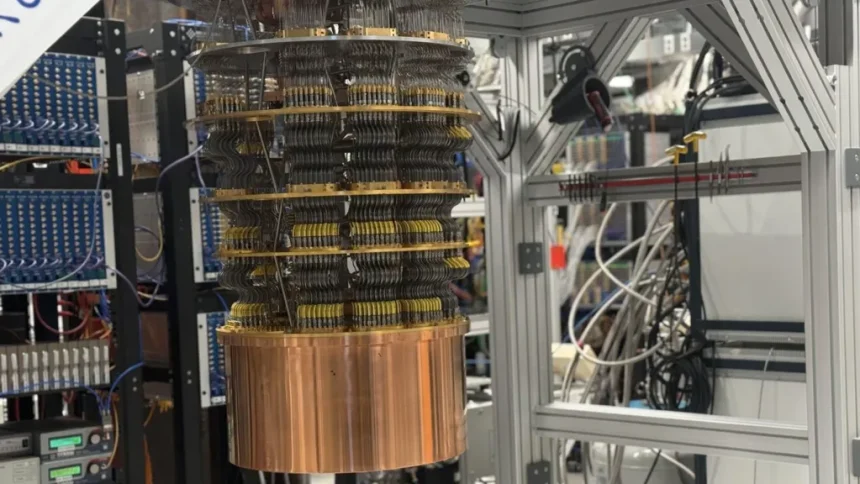
It looks like a golden chandelier, but it contains the coldest place in the universe.
What I am standing in front of is not just the most powerful computer ever built. It is technology that could reshape financial security, Bitcoin, government secrets, the global economy — and much more.
Quantum computing may decide which companies and countries win, and which lose, the rest of the 21st Century.
Suspended about a metre off the ground inside a Google facility in Santa Barbara, California, is a machine called Willow. And honestly, it wasn’t what I expected.
There are no screens. No keyboards. No holograms, brain-reading chips or sci-fi headgear.
Instead, Willow is an oil-barrel-sized stack of circular discs, connected by hundreds of black control wires that drop into a bronze refrigerator filled with liquid helium. Inside, a quantum microchip is kept just a thousandth of a degree above absolute zero.
It looks — and feels — like something from the 1980s. But if quantum computing lives up to its promise, the strange metal-and-wire “jellyfish” in front of me could transform the world.
“Welcome to our Quantum AI lab,” says Hartmut Neven, Google’s head of quantum computing, as we pass through a high-security door.
Neven is a near-legend in tech circles — part scientific pioneer, part electronic music fan. He dresses like someone who might have snowboarded straight here from the Burning Man festival, where he also designs art. Maybe he did, in a parallel universe — more on that later.
His mission is to turn abstract physics into working quantum machines “to solve otherwise unsolvable problems.” He admits he’s biased, but insists these machines are the best-performing quantum computers on Earth.
A secret temple of science
Much of our conversation focuses on what we’re not allowed to film. This lab houses technology wrapped in secrecy, export controls and global competition. Even tiny advantages — from component shapes to supply chains — can become powerful leverage in the race for economic dominance.
Despite that, the lab has a distinctly Californian feel. Each quantum computer has a name — Yakushima, Mendocino — and each is wrapped in contemporary art. Graffiti-style murals line the walls, glowing in the winter sunlight.
Neven holds up Willow, Google’s latest quantum chip, which he says has achieved two major breakthroughs. First, it settled “once and for all” whether quantum computers can outperform classical ones on certain tasks.
Second, Willow solved a benchmark problem in minutes that would take the world’s best classical computer 10 septillion years — that’s a trillion trillion years, with 25 zeros — far longer than the age of the universe.
That theoretical breakthrough has already been applied to a new Quantum Echoes algorithm. The task is impossible for conventional computers and helps scientists understand molecular structures, using techniques similar to those in MRI scanners.
Neven rattles off what he believes Willow could eventually help solve.
“It will enable us to discover medicines more efficiently,” he says. “It will help us make food production more efficient. It will help us produce energy, transport energy, store energy… solve climate change and human hunger.”
“It allows us to understand nature much better, and then unlock its secrets to build technologies that make life more pleasant for all of us.”
Some researchers believe true artificial intelligence may only become possible with quantum computing.
Members of the team working on this technology have already won a Nobel Prize for their earlier research into “superconducting qubits,” the building blocks used here.
Willow contains 105 qubits. Microsoft’s quantum project currently has eight, using a different method. The global goal is to reach one million qubits — the point where a “utility-scale” machine could reliably handle quantum chemistry and drug design without errors. The challenge is that the technology is extremely fragile.
A turning point
What’s happening here is being closely watched worldwide. Professor Sir Peter Knight, chair of the UK’s National Quantum Technology advisory board, says Willow marks a breakthrough.
“All the machines so far are basically toy models. They make mistakes and need error correction,” he explains. “Willow was the first to show you can do error correction repeatedly — and improve each time.”
That puts quantum computing on track to perform a trillion accurate operations within seven or eight years, rather than the two decades scientists once expected.
If the first 25 years of this century were shaped by the internet and then AI, the next quarter-century may well belong to quantum.
How quantum computers actually work
Imagine trying to find a tennis ball hidden in one of a thousand closed drawers. A classical computer opens them one by one. A quantum computer opens all of them at the same time.
Or picture needing 100 keys to open 100 doors. Quantum computing lets you open all 100 doors instantly with a single key.
These machines won’t sit on desks or fit in phones. But their power grows exponentially — and everyone wants a piece of it.
I ask Nvidia boss Jensen Huang whether quantum computers threaten his company’s dominance in AI chips. “No,” he says. “A quantum processor will just be added to computers in the future.”
But the stakes are enormous. One UK expert points out what’s really on the line: the ability to break almost any encryption, from state secrets to Bitcoin.
“All of cryptocurrency will have to be rethought because of the quantum threat,” Sir Peter says.
One major tech partner warned last year that Bitcoin may only have a few years before needing a stronger blockchain by the end of the decade.
In the industry, there’s even a phrase for what governments may already be doing: “Harvest now, decrypt later” — storing vast amounts of encrypted data today in the hope quantum machines can unlock it tomorrow.
A global race with China
Then there’s the international competition. China’s approach is very different from the commercial-driven model in the US and Europe.
China has reportedly committed around $15bn (£11bn) to quantum technology — possibly as much as the rest of the world’s government programmes combined, according to Sir Peter.
Since 2022, China has published more quantum research papers than any other country. Much of the work is led by physicist Pan Jianwei and is central to Beijing’s five-year economic plan.
China halted private quantum research by companies like Alibaba and Baidu, instead funnelling talent and infrastructure into a state-run system. Its focus includes quantum communications and satellites.
Last year, Jianwei unveiled the Zuchongzhi 3.0 quantum computer, claiming performance similar to Willow using a different approach. By autumn, it was opened for commercial use.
The atmosphere feels like the Manhattan Project or the Space Race — but for computing power.
The UK also plays a key role. British scientists pioneered superconducting qubits, and dozens of quantum companies now operate there. The government is expected to announce major new funding soon, seeing quantum as vital for the economy, defence and geopolitics. There is hope Britain could become the third global quantum power.
Parallel universes?
Back at the Willow lab, even bigger questions emerge.
Last year, Neven suggested Willow’s incredible speed might hint at the existence of a multiverse — that the computer could be tapping into parallel universes for processing power. Many scientists remain sceptical.
“There’s still a spirited debate,” he tells me. “Within one clock cycle, Willow can touch 2 to the 105 possible combinations at once. It makes you wonder — where are all these computations happening?”
One interpretation of quantum mechanics suggests many parallel realities exist. Willow doesn’t prove that, Neven stresses, but he says it’s “suggestive that we should take the idea seriously.”
This is the very edge of science, technology and economic power. Governments, including the UK’s, are preparing to pour hundreds of millions into catching up with Google and China.
It may sound like science fiction — but it’s quickly becoming economic reality