
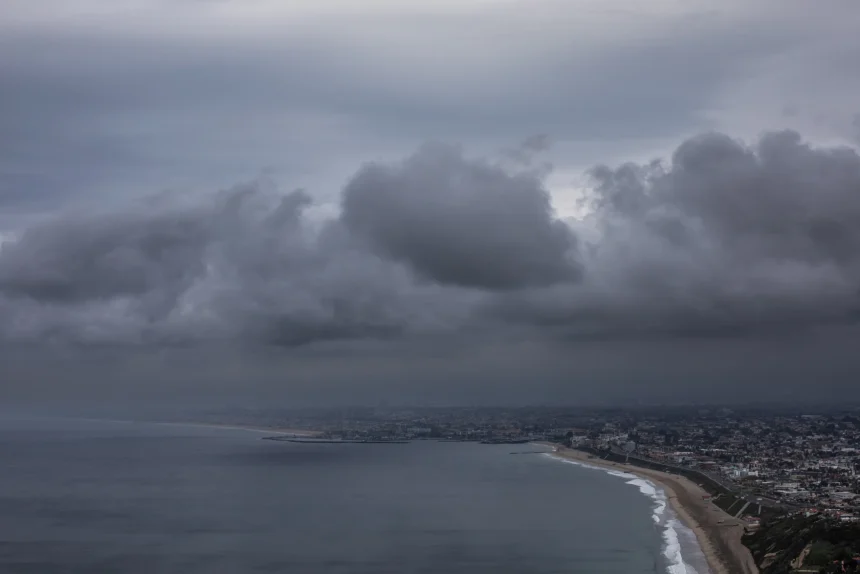
A flash flood warning was issued early Wednesday morning by the National Weather Service (NWS) in Los Angeles–Oxnard, putting parts of Southern California on high alert.
The warning was announced at 4:02 a.m. on Wednesday, Dec. 24, and applies to Santa Barbara County and Ventura County.
The NWS urged residents to take the threat seriously, especially drivers.
“Turn around, don’t drown when encountering flooded roads. Most flood deaths occur in vehicles,” the agency warned. “Be especially cautious at night when it is harder to recognize the dangers of flooding. Be aware of your surroundings and do not drive on flooded roads.”
Officials also cautioned that hilly terrain poses added risks due to numerous low-water crossings that can quickly become dangerous during heavy rain.
The flash flood warning is set to remain in effect until noon PST Wednesday. As of 5:45 a.m. PST, Doppler radar showed heavy rain across the affected areas, with rainfall rates between 0.5 and 1.25 inches per hour. Authorities say significant flooding is already underway.
What are NWS meteorologists saying?
In a detailed statement issued at 4:02 a.m., the National Weather Service said:
“The National Weather Service in Los Angeles/Oxnard has issued a Flash Flood Warning for: Southern Santa Barbara County in southwestern California, West Central Ventura County in southwestern California, until 9 a.m. PST.”
Meteorologists reported that between 1.5 and 5.5 inches of rain had already fallen in some locations, with rain rates reaching up to 10 inches per hour.
“Flash flooding is ongoing or expected to begin shortly,” the statement said.
The NWS listed the primary hazard as flash flooding caused by heavy rain, based on radar and automated rain gauge data. Expected impacts include flooding of small creeks and streams, urban areas, highways, streets, underpasses, and other low-lying or poor drainage areas.
Areas expected to be affected include Santa Barbara, Lompoc, Santa Ynez, Montecito, Carpinteria, Solvang, Goleta, Isla Vista, Buellton, Summerland, La Conchita, Lake Cachuma, Santa Barbara Airport, Hope Ranch, and major roadways such as Highway 101 through Gaviota State Park and Highway 154 over San Marcos Pass.
What is a flash flood?
According to the NWS, a flash flood is caused by heavy or excessive rainfall over a short period of time, usually less than six hours. These floods can develop rapidly, sometimes within minutes, and may occur even in areas that are not experiencing rain at the moment.
Flash floods are often marked by fast-moving water and can be sudden and violent.
What’s the difference between a flash flood watch and a flash flood warning?
A flash flood warning means flooding is imminent or already happening. If you are in a flood-prone area, you should move to higher ground immediately.
A flash flood watch, on the other hand, means conditions are favorable for flash flooding, but it has not yet occurred.
What to do during a flood warning
- Evacuate immediately if authorities advise it
- Use a battery-operated radio or TV for emergency updates
- Do not walk through floodwater — just six inches of moving water can knock you down
- Never drive through flooded roads; even two feet of water can carry away a vehicle
- Turn around and find another route if you encounter flooding
- Move to higher ground as soon as possible
- Stay alert and enable weather alerts on your phone
- Keep children away from flowing water, which may hide debris or hazards
- Watch for potential fire or electrical hazards
This weather report was generated automatically using information from the National Weather Service and was written and reviewed by an editor.