
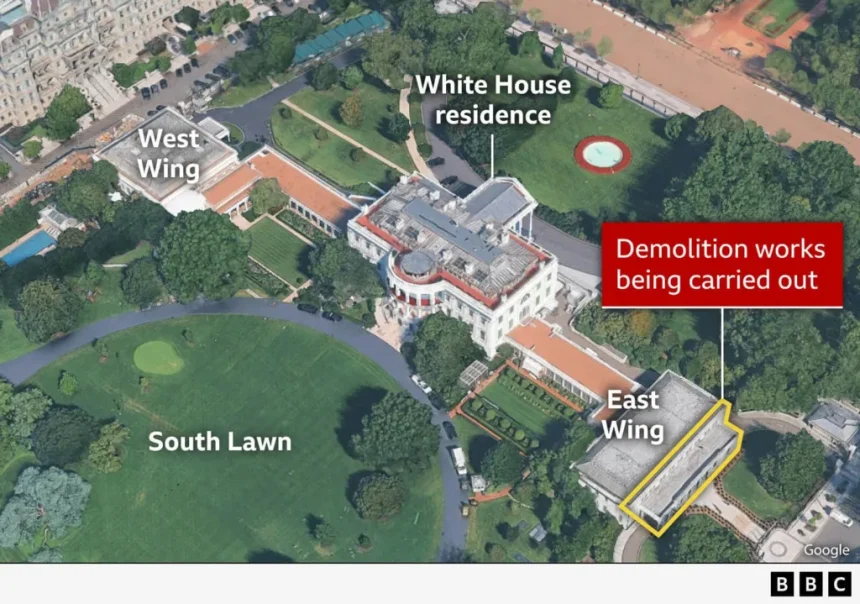
The White House says it was cheaper to demolish the East Wing rather than renovate it as part of President Donald Trump’s plan to build a new ballroom, pointing to major structural problems with the old building.
Josh Fisher, director of the White House Office of Administration, told a federal planning commission that the East Wing suffered from “significant deficiencies” and was poorly designed and built.
The East Wing was torn down in October to make room for President Trump’s new ballroom, a project he has said is being funded by private donors. The ballroom is now expected to cost around $400 million (£298 million), double the original estimate.
Speaking to members of the National Capital Planning Commission (NCPC) on Thursday, White House officials said the East Wing had long-standing issues, including “chronic water intrusion, accelerated deterioration and mould contamination”.
“Because of this and other factors, the cost analysis proved that demolition and reconstruction provided the lowest total cost ownership and most effective long-term strategy,” Fisher said.
Phil Mendelson, the Democratic chairman of the District of Columbia Council and a member of the commission, questioned why the full project had not been presented to the commission before demolition began.
Fisher responded by saying that some aspects of the ballroom project were of a “top secret nature”.
William Scharf, the commission’s chair — appointed by Trump in July — said the body typically does not have authority over site work or demolition, including projects at the White House.
Although the White House and its surrounding parks are overseen by the National Park Service, the president generally has wide powers when it comes to renovations.
The ballroom project is also expected to include a second storey added to the West Wing, which houses offices for White House staff.
Architect Shalom Baranes said the addition would help balance the look of the building, especially with the new ballroom being constructed on the opposite side of the White House.
He said the ballroom would cover 22,000 square feet and seat up to 1,000 guests for formal dinners. The plans also include two entrance lobbies, a commercial kitchen, an office for the first lady and a movie theatre.
Once finished, the ballroom is expected to be larger than the rest of the existing White House combined.
According to US media reports, a previous architect reportedly clashed with Trump over the size of the ballroom, warning that it could overshadow the historic building.
Baranes said the new East Wing, including two floors and the ballroom, will total just over 89,000 square feet (8,268 square metres). It will feature a two-storey colonnade connecting the White House’s East Room to the new ballroom.
For comparison, the main residence of the White House is 55,000 square feet, while the West Wing — home to the Oval Office and staff workspaces — covers about 40,000 square feet, according to the White House Historical Association.
A BBC-annotated satellite image shows the demolished East Wing area alongside the rest of the White House and the South Lawn, highlighting where construction is now underway.
In December, the National Trust for Historic Preservation, a nonprofit group created by Congress to help protect historic sites, filed a lawsuit against the White House in an attempt to stop the ballroom project.
The group argues that the White House failed to complete required reviews before demolishing the historic East Wing and should have submitted its plans to the commission before construction began.
The White House has said the ballroom will be completed before the end of President Trump’s term in January 2029.